Decision velocity and quality
Help people reach timely decisions with better information and clearer reasoning.
A companion to the session · Gothenburg · 22 October 2026
AI is becoming more capable, more personal and more able to act. The interesting question is no longer only what it knows. It is what you choose to do with it.
This is not a transcript and not a copy of the slide deck. It is the useful part to take home: the central argument, the frameworks behind it, and a few small experiments you can start tomorrow.
Three ideas worth carrying forward
The next step is not another chatbot tab. It is narrow, delegated work with a clear human owner.
02Use the reclaimed attention for customers, difficult problems, learning, the team and better ways of working.
03Small experiments beat abstract certainty. Start where you can influence the work and keep the human in the loop.
The shift
For years, most people met AI as a box that returned text. That interface is expanding. New systems can now carry context, use tools and pursue a defined task over time. The practical unit of change is therefore becoming the job, not the prompt.
That does not mean handing over judgment. It means describing a small piece of work well enough for AI to help carry it, then checking the result where the stakes demand it.
A useful progression
Ask a question → shape a workflow → delegate a bounded job → improve the system
“Whatever you are looking for, tailor it to your specific need. Be narrow in your question.”
From the stage, 10:16
If you want to see where the interface is heading, explore OpenAI Dots and Microsoft’s Autopilot introduction.
Start with the work
In the session, a mundane attendance report became the better AI story. It was repetitive, necessary and easy to verify. Turning it into a reusable agent did not change the world. It removed a small daily drag and returned attention to more valuable work.
A five-minute task repeated every working day is roughly two and a half working days per year. More importantly, a person stops serving the process and gains room to improve it.
“Save time isn’t the end goal. Save time is an opportunity.”
From the stage, 18:08
Not breaking systems. Understanding them well enough to make them work better.
Ask how the work actually moves, where effort accumulates and which assumptions have become invisible.
Choose one place where you can act. Build a small improvement instead of waiting for a perfect transformation programme.
Run the experiment, inspect the result and improve the instructions. Useful systems are trained through use.
Find the value
Look for AI’s value in decisions, energy, memory, risk, development and access, as well as time saved. The vectors are lenses for inquiry, not a guarantee of return.
Help people reach timely decisions with better information and clearer reasoning.
Reduce avoidable mental effort and make room for work that needs attention.
Make accumulated knowledge easier to find, connect and use.
Notice relevant obligations, inconsistencies and emerging risks earlier.
Support people as they learn, develop, contribute and share what they know.
Change who gets to participate and act, including across language, confidence and capability barriers.
Read the established presentation: Six Value Vectors.
Protect the human attention
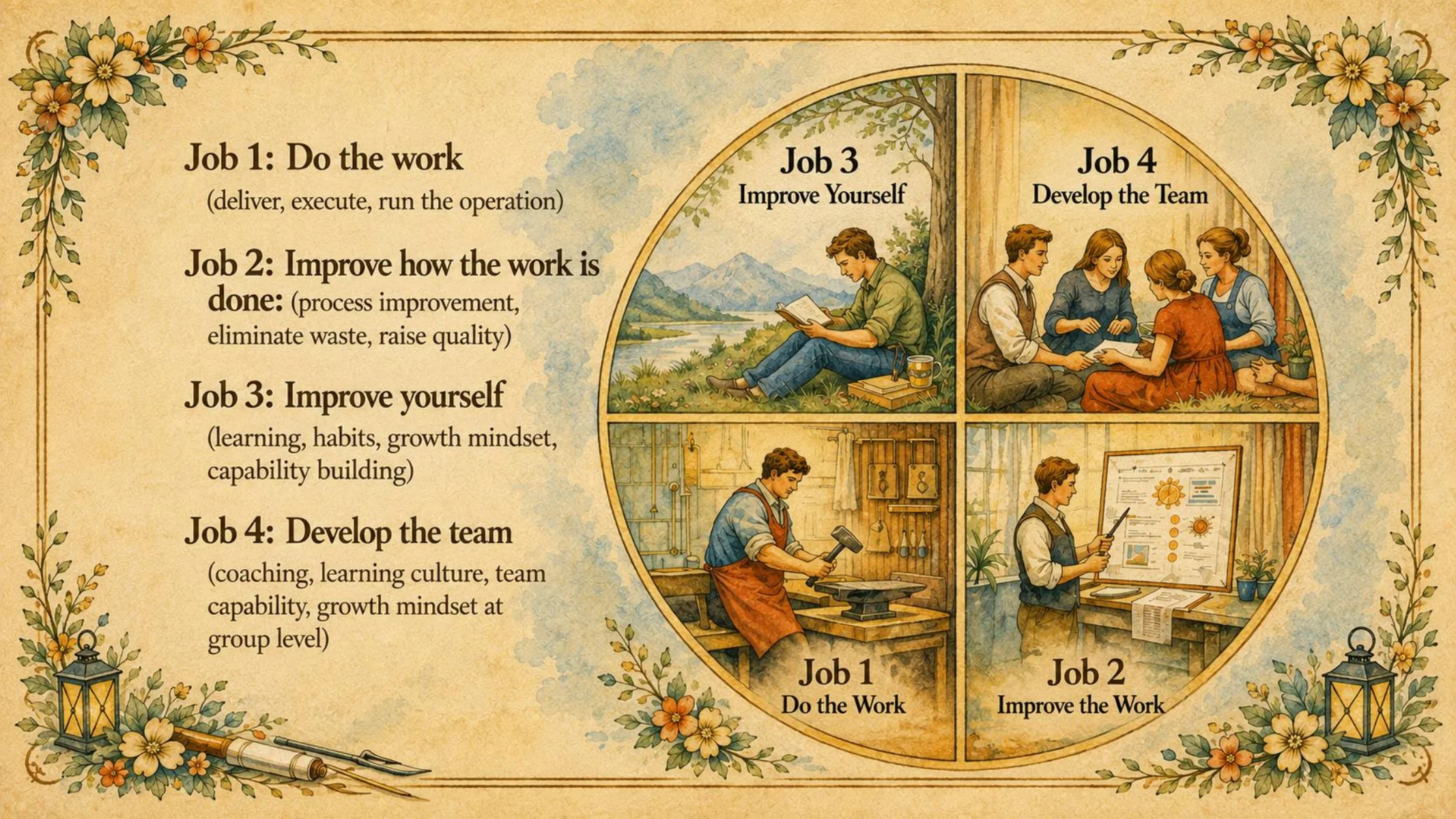
Create permission to explore. Let people find useful questions before demanding polished business cases.
Give people room to change the work they understand, not only report problems upward.
Turn experiments into repeatable practice through reflection, sharing and increasingly demanding tasks.
Match review, evidence and safeguards to the consequence of being wrong.
Put it to work

Make it a default participant in thinking and doing. Ask what it sees, what it can draft and which part of the work it can help carry.
Human review is not the same everywhere. Increase it with the stakes, reversibility and uncertainty of the decision.
Give it context, feedback and clear expectations. Do not assign it dignity, accountability or judgment that belongs to people.
Expect the tools to change. Invest in durable habits: framing work, checking evidence, exercising judgment and learning in public.
“There is no tech involved from your side. You talk to it like a human employee on the other side of the table.”
From the synthetic service-agent demonstration, 23:54
Prompt pantry
Replace the brackets with your reality. The first answer is material for a conversation, not a verdict.
Here is my role, the work I am responsible for and the things that repeatedly take my attention: [describe them]. Ask me five questions, one at a time, then suggest three useful ways you could help me this week.
Help me find a small, recurring task that AI could make easier. Interview me about work I repeat daily, weekly or monthly. Rank the candidates by time recovered, ease of verification and risk if the result is wrong.
Turn this task into a job description for a small AI agent: [task]. Define its objective, inputs, steps, output format, boundaries, escalation rules and the human review required. Keep the first version deliberately narrow.
Examine this process through the Six Value Vectors: decision velocity and quality; cognitive capacity and wellbeing; organizational memory and knowledge activation; proactive compliance and risk mitigation; talent lifecycle transformation; and access and inclusion. For each vector, suggest one plausible source of value and the evidence we would need to see. Then recommend the smallest worthwhile experiment.
Design a twelve-week AI learning journey for my role. Give me one increasingly demanding, real-work experiment per week. Include a reflection question, evidence of learning and a rule for when I should ask a colleague to review the result.
The session in one sweep
We moved from personal curiosity to practical agency: from cleaning up an image for fun, through the arrival of persistent agents, to a real example of delegating a repetitive internal task. We contrasted the hacker’s urge to improve a system with the leader’s responsibility to create the conditions for learning.
A synthetic aftermarket-service agent made the shift tangible. It could receive an ordinary request, reason within instructions and return a useful response. The point was not that every interaction should be automated. The point was that we can now shape small digital colleagues around specific jobs, then decide where people add the care, context and judgment.
The close was deliberately simple: do not wait to feel fearless. Choose a process you can influence, invite AI into it, and learn by doing.
“Think about the things you can influence. Find something where you can influence a work process inside your organization.”
From the stage, 30:58
Start tomorrow

What will you change tomorrow?
Keep going
Look for value in decisions, energy, memory, risk, development and access, as well as time saved.
SignalOne view of the shift towards persistent, context-aware AI collaboration.
SignalAnother view of AI systems that can take on bounded work over time.
Research trailThe Perplexity research link promised during the session, for exploring the pocket-agent example further.
Living experimentA transparent view of how I use specialised agents as a working system.
Current workCurrent projects, experiments and what is occupying my attention.
If one experiment becomes useful, tell someone. If it becomes confusing, tell someone even sooner.
Continue the conversation on LinkedIn Visit jardenberg.comThis companion was created from the delivered keynote recording and transcript, the final presentation used on 22 October 2026, the planning material behind the session, and Joakim Jardenberg’s current published frameworks. Quotations from the stage have been lightly cleaned for readability and carry approximate transcript timestamps.
The full slide deck is not published here. Selected framework slides were extracted where they add explanatory value. This page preserves the Six Value Vectors used in the delivered session and follows their established public wording.
Volvo Penta internal agenda material, poll results and raw exports, participant-level data, internal conclusions, identifiable group photography, unverified dealer-network figures and client-system details are deliberately excluded. The service-agent example was synthetic. The executive-assistant example has been generalised.
AI helped organise and render this material. Joakim selected the sources, set the boundaries and remains responsible for the published result. Appearance preference is stored only in this browser.